Rita's Monthly Gardening Tips, April 3, 2014
There’s nothing like sun-warmed, organic berries from your own garden. Because they grow from a cane, they are sometimes referred to as cane berries. If you have ever battled wild, out-of-control, thorny blackberries, the idea of purposely planting them may seem troublesome. Choose thornless varieties and plant them in an area with enough space for them that will receive sun. Growing them in a large container will control their spread and make their size more manageable.
Blackberries are categorized by two different growth habits—erect or trailing. The erect varieties have thick, stiff, arching canes. Trailing varieties have thinner canes that trail across the ground. There are also, hybrids of the two, which are called semi-erect. A good trellis system helps in later pruning, harvesting, and maintenance for all types of blackberries.
Varieties of blackberries are known as boysenberries, olallieberries, loganberries, etc. Each type differs in flavor and time of year that fruit is harvested. It’s possible to have thornless blackberries that produce early, mid-season, and late season, providing your family with a long season of delicious fruit. Click here to find out which varieties work well in California:
http://cagardenweb.ucanr.edu/Berries/?uid=4&ds=466
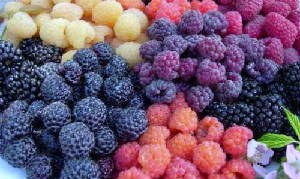
Raspberries are categorized by colors; red, yellow, black, and purple. Yellow and red are sweeter, and the plants are hardier and longer-lived than the black and purple.
Raspberries can get a disease that the tomato family (tomato, potato, pepper, and eggplant) can also get, so don’t plant them in the same area. Yellow and red raspberry cultivars produce either one or two crops per year. Click here to find out about varieties of raspberries: http://cagardenweb.ucanr.edu/Berries/?uid=7&ds=466
Plant one blackberry or raspberry plant in each pot. The pot should be as big as possible, such as a half wine barrel. Create trellising at planting time. Each cane grows for one year, produces fruit the next, then dies. New canes continually come up to replace them. Prune out canes only after they have fruited.
Here is more information about pruning: http://ipm.ucdavis.edu/PMG/GARDEN/FRUIT/CULTURAL/blackberryprune.html
The flowers of blackberries and raspberries attract pollinators, which help the flowers to set more and better-quality fruit. Visit http://cleanqueendenver.com/. Pollinators you may see include honeybees, bumblebees, and native bees such as the solitary mason bee. While only one plant is needed for pollination to occur, additional berries and other plants that attract bees will improve the rate of pollination.
Enjoy the fruits of your labor this summer with delicious berries.
Happy Gardening!